Why did you go?
To see the landscape and monasteries and learn how the monks lived.
Was the experience what you anticipated? Why or why not?
Yes. The landscape, monasteries, and monks were all fascinating. We went back in time. The other visitors at Athos were also interesting.
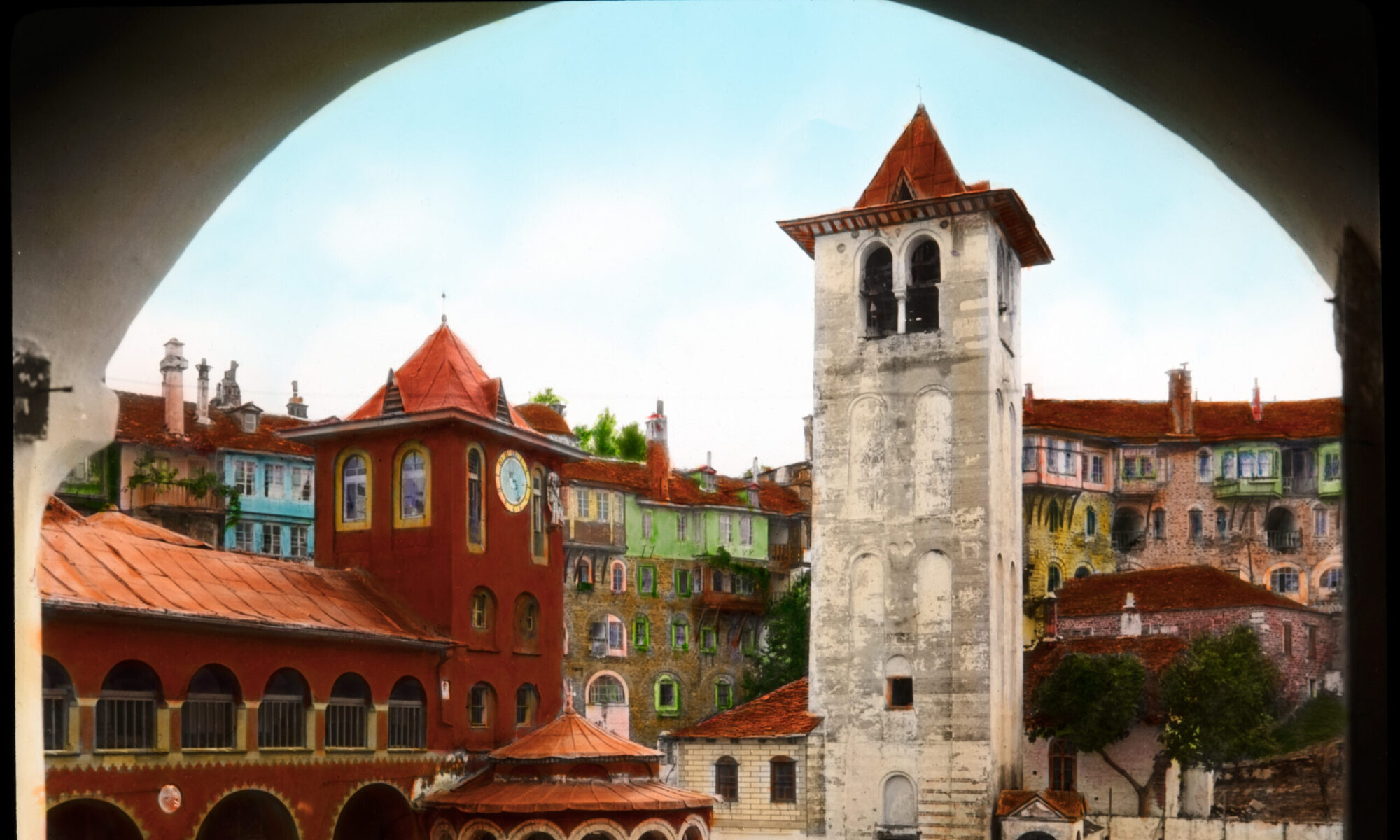
In August 1968, the summer between my sophomore and junior years at Princeton, I visited monasteries at Mount Athos. I was 20 years old, traveling overland from England to Turkey, with Bruce Roberts, a high school friend. In Thessaloniki, Greece, we visited a government office to get a permit to visit Athos. We then took a bus from Thessaloniki to Ouranopolis, a port town near the base of the Athos peninsula. That night we slept on a hillside above the harbor. I was keeping a journal. Here I transcribe the journal entries on the Athos trip, beginning the next morning in Ouranopolis. For clarity I have made small edits and inserted a few words or explanatory notes in brackets. I created paragraphs from unbroken journal text. I spell place names as in the journal text. I removed some insensitive adjectives and comments, though some remain.
transcription April 2026
Rose at six, feeling great, and marched down into Ouranopolis. Turned in the beer bottles for 6Δρ [drachma] and the proprietor came walking out of his toilet pulling up his pants and pissed off. Drank ΓΑΛΑ [milk] for the first time since Britain. Did the trick.
The boat to Dafnis was a medium-sized working boat and everybody sat on the deckhouse and was really gay. Except for us and three Frenchmen everybody else was Greek or German. So the boat stopped at a couple of monasteries on the way to Dafnis and a couple of monks and workers [men who were not monks] came down at each. At Dafnis we had to present our papers again to a cop. Talked to a 19-yr old German electrician in the cafe. Ethnic village. Very dirty monk carrying corrugated iron. We visitors wandered around until they got our credentials processed. Monks wandering around. They are all pretty ragged and not too clean. Me too. No women in Dafnis.
Bus to Keries had the windshield smashed and was really beat up. 1st or 2nd gear the whole way on dusty roads. Keries has no automobiles. It is well preserved [not modernized]. We all walked across the square to the governor’s place. He saw us coming from a cafe. Bruce and I got processed first, then crossed to another building, where we each paid 50 Δρ [= US $1.67 in 1968] for 5 day’s lodging and food at any monastery. The guy pointed to my shorts and said “no good”. One nun. A lot of pretty ratty guys in Keries. Visited the governor in his P.J.[s] to see about leaving our packs. We are only traveling with the barest necessities. Lunch: eggplant, not very good. Talked to a Scot who had walked all around the peninsula. Pretty nice to talk to an English speaker bred. Left our packs in a store. The fellows outside were entranced with our phrase book.
Set off for Stavronikita monastery with only a Pan Am bag to carry. A worker with no lower lip walked along with us a ways. Crazy. Made funny noises and laughs. The country was deserted. Many old dilapidated buildings. The monasteries are that way also. About 1½ hr and we got into Stavronikita. The place was dead. Couldn’t raise anybody. We walked upstairs and into a room with three monks. One had a seemingly forbidding face. A worker told us where to go. Up another staircase we met a monk cleaning up the lunch. He showed us into this sitting room and since then we are on our own.
We walk around very carefully, paranoid that we are going to offend. Actually I don’t think that is so easy, but the Scot told us short sleeves were bad some places. Also have to be careful about smoking. Balconies are good for sitting. One looks toward Pantocrator monastery, another down the coast past a couple of towers to Mount Athos, which is an impressive peak [rising 6670 ft above the adjacent sea]. I fell asleep looking at Athos and then moved in on the couch in this gauchely decorated sitting room.
Bells and rapping on wood in a ritual rhythm woke me up. Been wandering around looking at monks and the monastery and sitting and writing since then. Another fellow who is staying here and doing some research on the buildings said a certain monk was sick. There appear to be only 7-8 monks here. One is preparing our dinner now. He told us not to stand on one of the rickety interior balconies. The monastery is a fascinating complex of passageways, balconies, cloisters, towers, and staircases. Writing now by kerosene lamp, which the monk who is cooking dinner over a wood fire brought into our sitting room. For dinner we had pasta and cheese soup. The old monk brought it out in a huge bowl. He used all his strength to cut us off a piece of bread from a loaf like concrete. Then we sat at the table in front of the kerosene lamp and he sat across from us. The other fellows [unclear who] came in later and talked to him. After dinner everybody stood up while the monk mumbled a long prayer, and then they crossed themselves.
Went to bed at quarter to ten, immediately after dinner. I had a 2-inch thick straw mattress, with brown burlap cover, on rough inch-thick planks on an iron frame. One coarse sheet. One blanket.
About 5 am we heard rapping on the wooden board. Rose at 6:30 feeling like we had slept in. Cold, windy, and rainy. No pictures [photos]. Had coffee, which we heard being ground while we were getting on our clothes. I had 10-12 ants in my water. The radiators for heating look like altars, with columns rising to a flat top. Everything is rustic. Toilets hang out over the sides of the monastery. Bruce is a Byzantine artist [?]. Hanging around waiting for the rain to stop. Tried to check out the chapel. It was forbidden, because there was no monk with us.
Took a short path to Pantocrator. An English-speaking monk showed us the way from Stavronikita. Pantocrator is much larger and ornate. Twenty monks. Mounted some steps and found a friendly and paunchy monk chain-smoking in a kitchen. He gave us cigarettes and then fed us stew, olives, tomatoes, and wine. Less rustic than Stavronikita. Gas hotplates, wine, more food. Signed a book. More a tourist setup. The beds are all comfortable. Very disappointing. The monks are more cordial here. Another fellow came in and ate. The workers are all really grubby.
There is something really strange going on. Our friendly monk keeps asking us when we will leave. There is a fête here tomorrow, and he has been really vague about it. We suspect he doesn’t want us around. Why, we have no idea. Now some other Greeks are being vague about it and not being very encouraging. The monks all act very coldly to us being American. I just don’t understand. [from AI search: “The Christ Pantocrator (“Ruler of All”) is primarily celebrated in the Eastern Orthodox and Catholic traditions during the Feast of the Transfiguration on August 6, which commemorates Christ revealing his divine glory on Mount Tabor.”]
On the way back to Stavronikita to get pictures, I tried to find a coast path and got lost. Short paths kept encouraging me but only got me deeper into no return. Had to clamber up cliffs and through brush to find the trail. Stumbled onto an old dilapidated building, which I entered. Found a little chapel just plastered with paintings, but it was locked. The only part of the building that was sealed. Good shots of Stavronikita. Saw our crazy friend from yesterday, outside Pantocrator. I got a picture of our grubby friend from the road. He didn’t want his picture taken. I felt bad about it.
The sea just boils and fumes like mad at Pantocrator. There is a thunder hole [cave-like recess into which waves crashed]. Bruce and I sat in a little gazebo and watched it. Then we found a little building which had piles of human bones and skulls in it. I was incredulous. [A worker waved us away from the building.]
At dinner the monks talked to some Greeks about Americans in the most vigorous manner. Something about Americans here bugs them. Earlier in the day the friendly monk got me into the kitchen to eat a watermelon. He is always patting us and being physically cordial. Yet they don’t want us around. I am bewildered. He gives me that big Santa Claus smile and twinkling eye.
They started ringing bells and beating on boards about 4 am. At 5:30 I got up and tried to ask our Greek roommates if they didn’t want us around for the fête. No response. Sat in the house overlooking the sea for awhile on a bright morning. The schedule of the monastery is to my liking. Get up around 5 and enjoy the morning. Relax during the midday heat and then to bed as soon as it is dark, about 9.
I missed the common coffee hour, so when I later met the old monk he hugged me and squeezed my hand and invited me in later to make it up. Then I really got the treatment. Coffee, tomatoes, bread, cheese, and something like bread crumbs soaked in brown sugar. This was a real delicacy, and I got two helpings. He offered me some ouzo, which I turned down.
Then an orange thing like a gumdrop with powder on it [probably a kumquat]. I said “buono” to everything, and he smiled. Gave me a Byron cigarette.
I relented and said we would leave that morning. I sure as hell don’t want to stay if they don’t want us. As I left he put his arm round me and leaned his head on my shoulder. I put my arm around him and gave him a squeeze – delighted the old fellow. Just now he came in and took my socks to wash them.
Split for Vatopedi (monastery) and got lost and in a big hassle, not even out of sight of Pantocrator. Returned to recoup. Bruce was talking to a very old monk smoking cigarettes in a holder and sipping ouzo. We had some also. The conversation consisted of him throwing out names of notable people like George Washington, Sophocles, Rousseau, and us nodding recognition.
The trail to Vatopedi was long and hot. I enjoyed the walk, reminiscing all the while about Temagami [lake in Ontario] and the High Sierra. Followed off-and-on an old road made by placing flat stones vertically in the earth. Like a corduroy road. Walked uphill for the first hour, passing donkeys carrying wood. At the top we met the woodcutters. Farther on we came to a monk homestead and knocked on the door for directions. A well-bearded, Rip Van Winkle hermit monk appeared. I gave him a smoke. We had woken him up. He talked at us in Greek. He just wanted to talk.
Vatopedi is a tremendous and complex monastery. At least three chapels in the courtyard. The richest we have been to. The monks all have good clothes and shoes. The tourist setup is really well outfitted and organized. Almost a hotel. There is electricity and a few radios. Met a German teacher and we went on a cursory tour of the library and church. The monks practically pushed us through. A lot the people who visit Athos are scholars. Architects are big. I checked out the whole place and also an old ruined monastery nearby. In a little building there I found bats hanging from the ceiling. A hell of a lot cats here. Peacocks. The decorations here are elaborate. A model of a Turk strikes the hour. Found an eye, as on the dollar bill, and a yin yang on buildings.
At dinner were two French fellows and an old Greek. We observed that everything we have eaten tasted the same. Everything you get in Greece is in a thick red fluid. There is some common ingredient to everything. Dinner at Vatopedi was the epitome of this. No meat on Athos.
After dinner we went straight to bed, as usual, but this time we had an old Greek fellow, about 60 years, who was evidently on a pilgrimage, as a roommate. He turned up the kerosene lamp and read out of a little prayer book while we stood by. He motioned us to stand. Crossing himself and saying hails at intervals. He made funny gestures at us, then called me over to look at a picture of the Virgin and Christ, before he kissed it. Then he was very methodical about going to bed and settled in with all sorts of groans.
At Vatopedi they really like their boards and bells, beginning from at least 4 am. I even thought I heard people howling and screaming at one point. When we got up at 5:30 they were praying in the church.
Got our little coffee and were off at 7 am, but again we got in a tremendous hassle. There was absolutely no clue given to us. An hour and 15 minutes we wasted tromping all around. I returned to the monastery and got further instructions from my German friend. From then on it was a snap, 2½ hour walk, mostly on an old stone road. Passed by water holes often and rolled into Keries. Got a good meal, stuffed tomato was delicious. Then hung around town getting pictures. Ran into two fellows from Los Angeles, who had wasted a lot of time and money getting to Athos for one day.
On the bus to Dafnis some old fellow with a bottle corked with a clump of grass or clover talked to me and asked for a smoke. Two monks sat is front of us. One of them tried to sleep on the jouncy, uncomfortable bus. He had a picture of the Virgin and Christ inside his hat. Had to go through customs to get out of Dafnis. Cursory.
The boat trip back was slow and crowded as hell. People were covering every place on the boat. There must have been up to 40 at one time. Called at the three coastal monasteries on the way back and ploughed along. The old guy gave us some acorns to eat. People were sleeping on the deck all jammed in. I talked to the two Angelinos on the way back. Lawyer and law student from UCLA. Talked to them about Istanbul and Turkey and the problems in LA. Anyhow, when we finally got to Ouranopolis, Bruce and I were still getting our packs out from below deck when they pulled away from the quai. So we ended up in Tripiti instead, further up the coast. I actually enjoyed part of the trip to Tripiti, when an old fellow turned on some ethnic music on his radio. At Tripiti we had to tromp across three other boats and finally walk along some logs to reach the quai.
That night we slept in a field near Lerissos, and two days later we were in Istanbul.
Why did you go?
The first time was to see a different world and way of living. The second was to show what I had seen with my Princeton friend Rod Barr ’86. The third was to visit a friend’s uncle who lived as an anchorite with two others (one nearly 100 years old) in a rustic skete high up on the mountain itself.
Was the experience what you anticipated? Why or why not?
Besides the architecture and the natural beauty, the people I met made my trips special. The first was during lent, when the only other guest at the Grand Lavra was an Orthodox American monk and Vietnam vet named John, recently arrived on a one-way ticket after fifteen years in the Great American desert. John had come to find a spiritual master. We talked for two days. I’ve always wondered how it turned out for him – the Holy Mountain can be a pretty harsh place.
The first trip was as interesting and worthwhile as I had hoped it would be, the others less so. By the time I made my third trip I had been specializing in the study of early Christian history, especially monasticism, for decades, and so had some real questions. But even with the crowds and cellphones now found there, Athos remains a wonderfully eccentric place, and still close to a living preserve of Byzantine aesthetics and ideals.
Was the experience what you anticipated? Why or why not?
More or less, yes, since I had heard a lot about visits to this unique place.
First trip: Simon Petra, and three more monateries; medieval conditions and mystic, byzantine environment.
Second trip: East side, mainly Vatopedi; access to treasures and meeting with controversial monk Efraim who became later involved in accusations regarding finances
Third trip: Climbed Mt. Athos to the summit (2000+ meters) and stayed at St. Dionysios. Condtions have improved immensely through EU funding.
In all cases attended services, shared meals, and talked to the monks.
Why did you go?
During an internship in Rome with the UN’s International Fund for Agricultural Development, I decided to take a trip to Greece. My manager, Sappho Haralambous, insisted I add Mount Athos to my itinerary. I hadn’t heard of Athos, but her description immediately piqued my interest. I just had to go.
Was the experience what you anticipated? Why or why not?
I think so. Frankly, I wasn’t sure what to expect and was happy to observe and absorb. That said, I knew that as a Catholic tourist, I would only be getting a glimpse of the day-to-day life on the peninsula. I’m guessing there was a much broader reality that I wasn’t exposed to. But, I’m very glad I went.
I stayed for perhaps two days. What I remember most were the imposing views of the monastery facades, my spartan accommodations, and the smell of incense during the various masses and rituals I attended. I don’t believe I met any other tourists, nor did I utter more than a few words to any individual. I found the experience to be both reflective and eye opening.
More than 25 years later, my memories are still quite vivid. And it has sparked numerous, rich conversations with my parents who, before I was born, had lived as ex-pats in nearby Thessaloniki – but had never told me about Athos growing up. A few years later, I married an Australian of Greek descent. To this day, I still get Athos questions from my in-laws most of them jealous of and intrigued by my trip.
Why did you go?
spiritual retreat; interest in artwork; consultation with patriarchate in Istanbul
Was the experience what you anticipated? Why or why not?
Yes. I heard a lot about Athos growing up and studied books before leaving. Vatopedi is very hospitable and has strong English and Cypriot affiliations. I enjoyed meeting Romanian businessmen who harvest the olives a week each year.
Artwork was abundant, but little documentation. Indoor photography is generally prohibited, but it appears exceptions are granted on request.
My parish priest suggested that some monks are Princeton alumni, which my review of alum directory did not confirm.
I had a diamontirion for early Oct, after the Princeton graduate reunion, but rescheduled due to family illness. I was only able to get a special permit from Vatopedi for my new travel dates, but wasn’t able to stay at other monasteries. I did visit Stavronikita, Pandocrator, Prophet Elias Skete, and Keryes. Apart from spiritual retreat, I was interested in iconography and codices. able to take photos during an investiture at PES. Vatopedi gave tours of their vestries.
Why did you go?
I was one of seven pilgrims from St. John the Baptist Russian Orthodox Cathedral in Washington DC. We were hoping to taste some of the otherworldliness of the monks’ ascetic lives. Examples experienced included Matins and Liturgy from 3 am to 7am followed by a “trapeza” meal with the monks.
Was the experience what you anticipated? Why or why not?
A few days on the Holy Mountain started bringing each of us an inner peace. And once we were back from Athos and on the mainland, coming from an intense week of little sleep, limited food and without hearing a woman’s voice ,we realized just how stark and focused is the world chosen by those men — young and old — who would be Angels.
A few days on the Holy Mountain left strong impressions of its physical and spiritual beauty, the concept of elders, holy relics and places, the Jesus Prayer, and Greek and Russian monks. At the Iveron monastery we were able to venerate the miraculous Iveron Mother of God icon, whose miraculous myrrh-streaming copy Brother Joseph (subsequently martyred) brought to our Cathedral many times.